






- Colour-coding scrubs by department helps staff, patients and visitors tell teams apart, and patient surveys show strong support for it.
- There is no universal scrub colour code, so every hospital builds its own plan.
- Keep the plan small, give OT, ICU and Emergency colours that cannot be mixed up, and back every colour with a name and role badge.
- A code is only as good as its shade. Order each department colour in the same fabric, every time.
A patient in a large hospital may meet dozens of staff in a single day, and most of them wear scrubs. When every team dresses in similar blues and greens, it is hard to tell the ICU nurse from the ward nurse, or the OT technician from the lab assistant. Visitors ask the wrong person for help, and staff from different departments lose a few seconds working out who is who.
A department colour code solves much of this at very little cost. This guide is for hospital administrators, nursing superintendents and purchase teams who want to build one, from the first plan to keeping the colours consistent order after order.
Why hospitals colour-code scrubs
The case starts with patients. In a 2014 Harris Poll commissioned by Cintas, 83% of US adults said they found it difficult to identify employees in a hospital, and 68% found it hard to judge a staff member’s role from the uniform. A 2013 Vestagen survey of patients and family members found that 89% would find it helpful if scrubs were colour-coded by role.
Hospitals that have tried it report results. Regional West Medical Center in Nebraska ran a pilot in which registered nurses wore one colour, and 58% of surveyed patients said they could identify their nurses more easily. In the UK, NHS Scotland has used standard colour-coded uniforms since 2009, and NHS England has introduced a national uniform in which each profession has its own colour.
Staff benefit too. During a handover, a ward round or an emergency call, a glance tells a nurse which team a colleague belongs to, without stopping to read a badge.
What to code, department, role or both
Before choosing colours, decide what the colour should say. There are three common approaches.
- By department. Each department has one colour. This is the simplest to plan and to explain to patients.
- By role. Nurses, assistants and technicians each have a colour, wherever they work. This is the NHS approach.
- Colour shows the department, and a name and role badge or chest marking shows the role.
For most hospitals the third approach is the practical one. The same American Laundry News report noted that four to eight colours worked best for a scrub programme, and coding department and role together by colour alone quickly goes beyond that. Let the colour carry the department and let the badge carry the role.
Building a simple colour plan
Start with a one-page plan. Four steps are enough.
- List the departments where staff spend most of their shift.
- Group small units that can share a colour, so the total stays within about eight.
- Give neighbouring departments colours that contrast clearly, and avoid two similar blues on the same floor.
- Write the plan down with the colour name and fabric for each department, and get it signed off by nursing and administration.
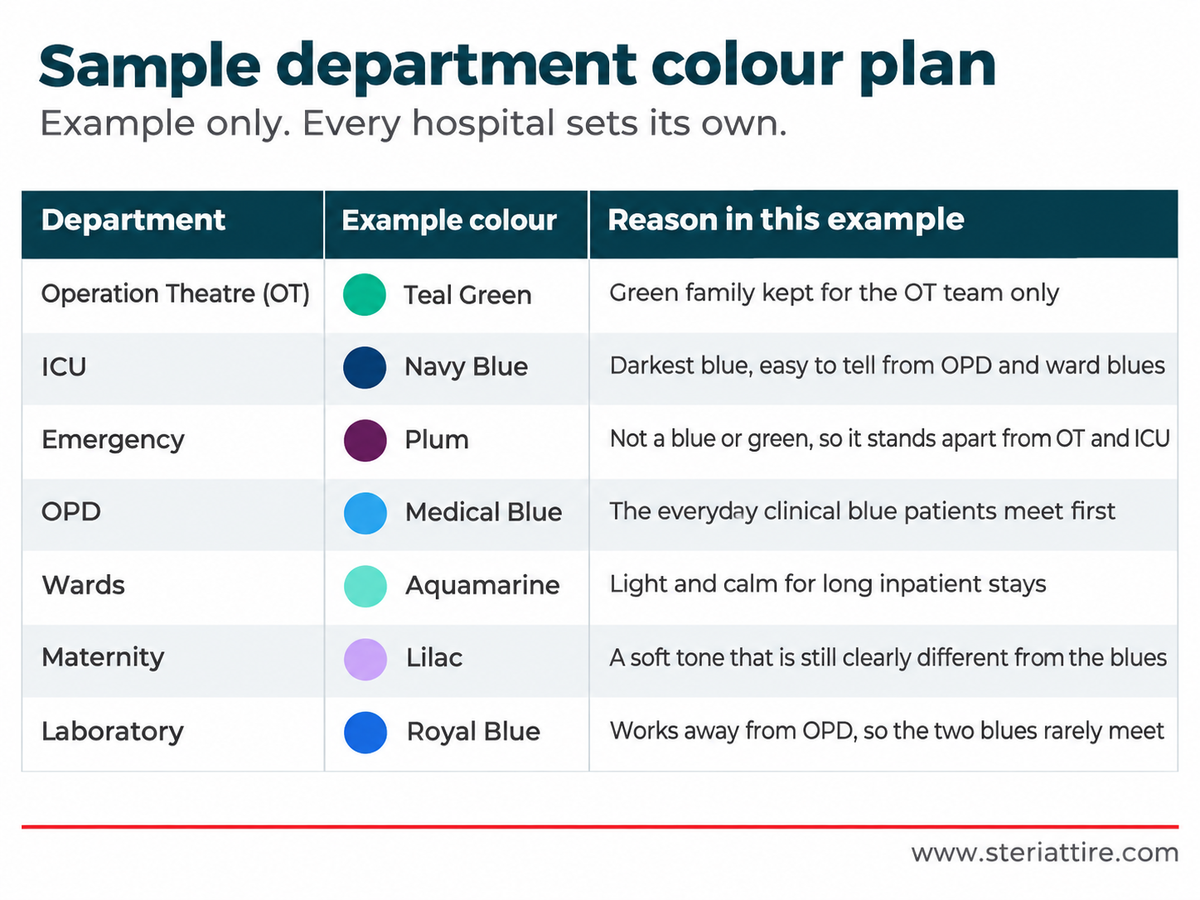
The table below shows how such a plan could look. It is an example only, built from SCRUBNOVA colours, and every hospital should set its own.
Keeping OT, ICU and Emergency clearly apart
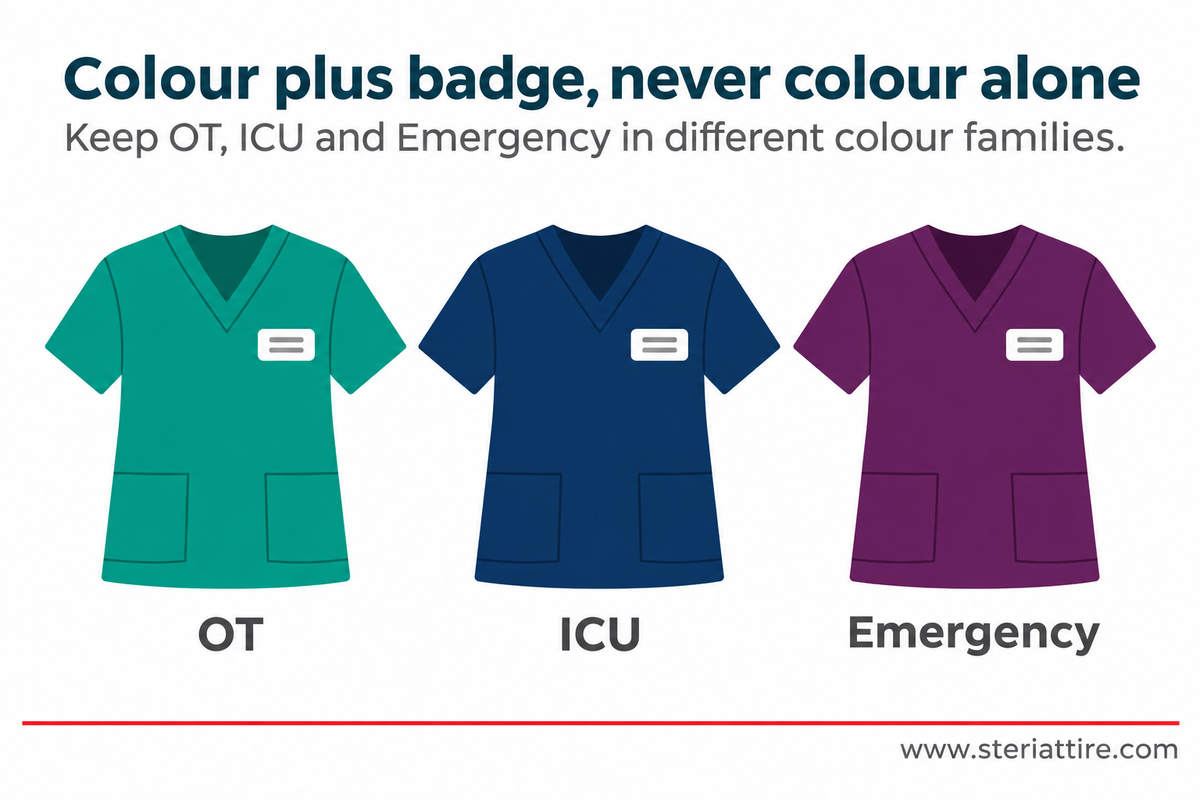
These three areas see the most movement at critical moments, so their colours need the most thought. Keep them in different colour families, for example one green, one dark blue and one tone that is neither. Avoid giving any of them a shade that sits close to a ward or OPD colour.
Colour should never be the only cue. A July 2026 article from Pennsylvania’s Patient Safety Authority points out that lighting, stress, visual overload and differences in colour vision can all change how people read a colour, and calls colour on its own a weak safeguard. Pair every scrub colour with a clear name and role badge, and brief code teams to confirm roles out loud during an emergency
Rolling out the code
A colour plan works only when everyone knows it. A simple rollout covers the following points.
- Brief staff before the new sets are issued, so nobody is surprised on the first day.
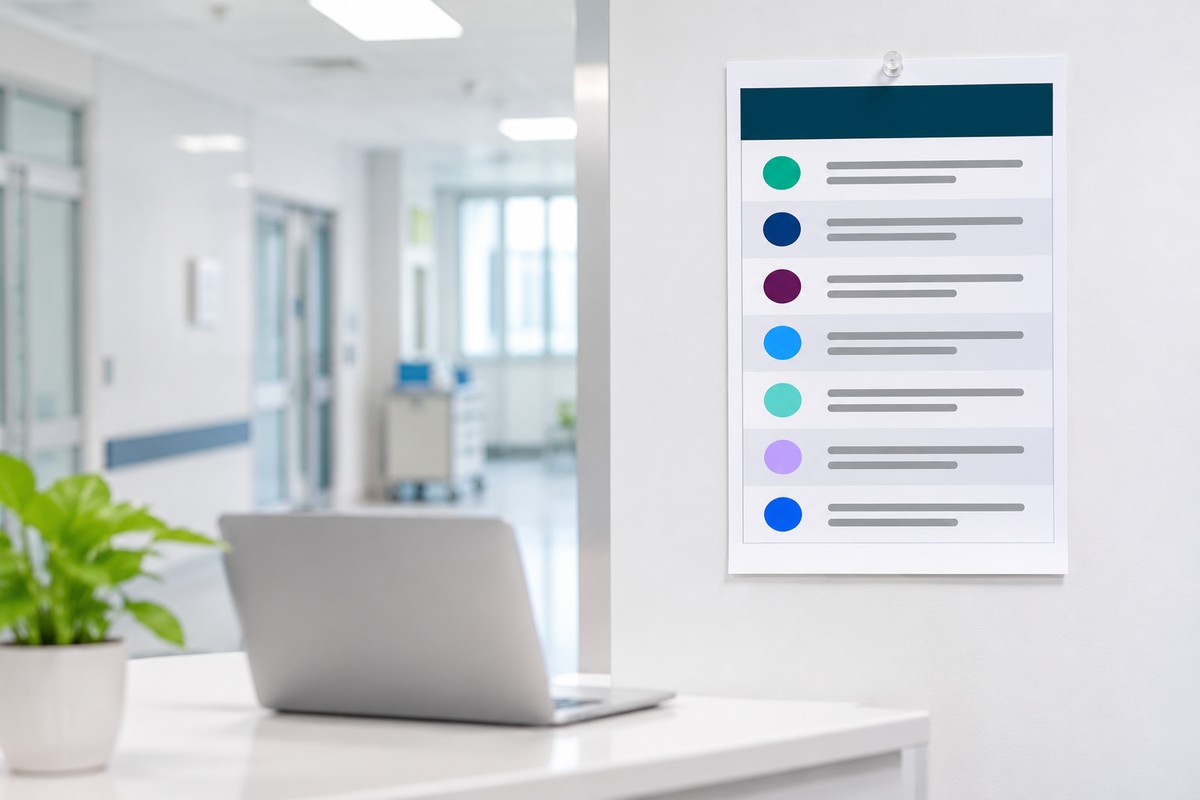
- Put a one-page colour chart at reception, in lifts and at every nursing station, so patients and visitors can read it too.
- Give the chart to every new joiner with their first set, and include agency and contract staff.
- Review the plan after a few weeks and adjust any pair of colours that staff still confuse.
Our next guide covers a full scrub rollout across a hospital, from sizing and pilots to reorders.
Keeping the shade the same order after order
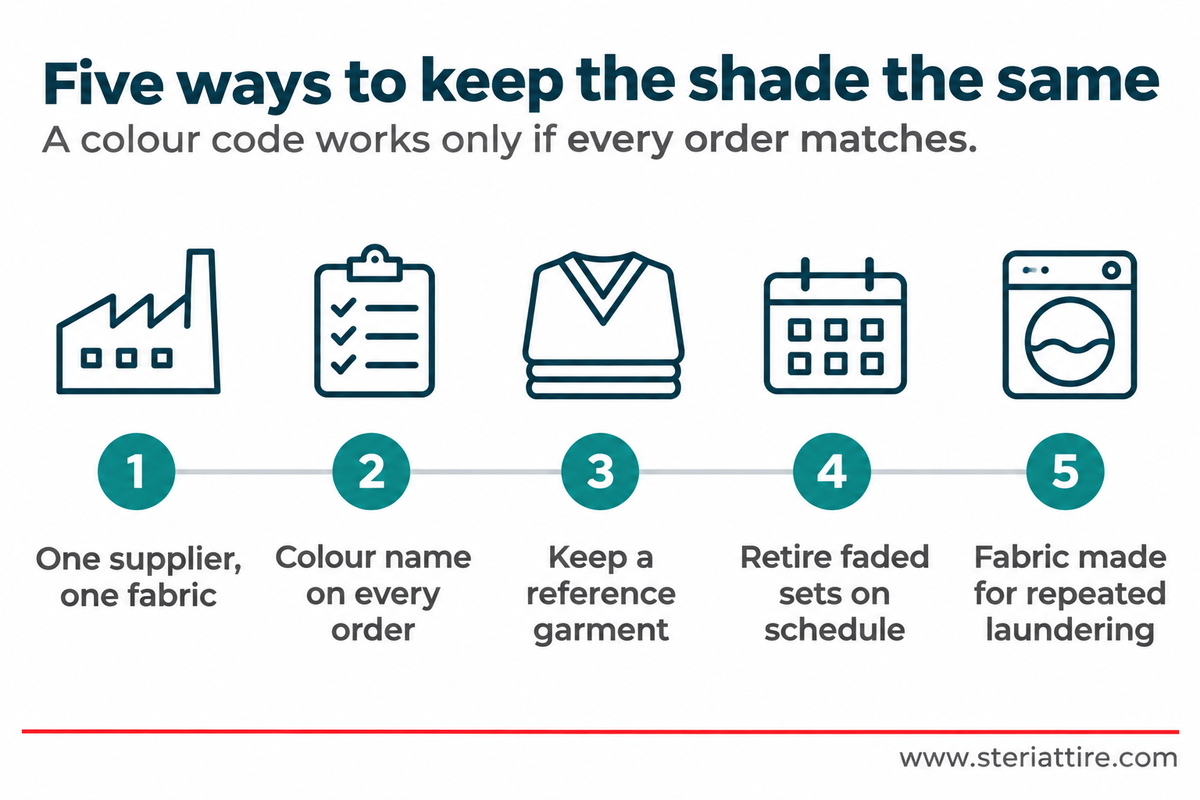
A code only works if Teal Green stays the same teal. When one batch comes in a different shade, or two suppliers make the same colour differently, the code starts to blur and staff in the same department no longer match.
- Order each department colour from one supplier, in one fabric.
- Record the colour name and fabric on every purchase order.
- Keep one reference garment per colour for checking new deliveries.
- Retire faded sets on a fixed schedule rather than mixing old and new.
- Choose fabrics made for repeated laundering, so colour holds wash after wash.
Planning your code with the 14 SCRUBNOVA colours
SCRUBNOVA by SteriAttire was built with hospital teams in mind. The range includes separate male and female scrub suits in three necklines (V neck, O neck and Classic Mandarin collar), two fabrics (PC knitted and Poly Viscose) and sizes from S to 4XL. With 14 colours, a hospital can give every department its own shade and still keep spare colours for new units.
SCRUBNOVA scrubs are made for repeated laundering and autoclaving, under ISO 13485:2016 quality systems. Your hospital logo can be added on the chest through embroidery, heat transfer labelling or DTF labelling, so every set shows both the department and the hospital.
If you are planning a colour code, send us your list of departments and team sizes, and we will help you match each one to a SCRUBNOVA colour and fit.
Telling teams apart at a glance makes a hospital easier for patients and smoother for staff, and a clear colour plan is the simplest way to start.
Plan your colour code with us at care@steriattire.com or +91 72111 87998 · www.steriattire.com
Frequently asked questions
Is there an official colour code for medical scrubs?
There is no universal scrub colour code. Each hospital sets its own, and the plan in this article is a guide from SteriAttire to help start one.
How many colours should a hospital use?
A survey reported by American Laundry News found that four to eight colours worked best for a colour-coded scrub programme. Fewer colours are easier for patients and staff to remember.
Do the top and trousers have to be the same colour?
One colour for the whole set is the simplest to read. Some hospitals split it, for example a coloured top with neutral trousers for one unit, as Regional West Medical Center does for its birth and infant care staff.
Can our hospital logo go on colour-coded SCRUBNOVA scrubs?
Yes. SCRUBNOVA can carry your hospital logo on the chest through embroidery, heat transfer labelling or DTF (direct-to-film) labelling.
Sources
- Becker’s Hospital Review, The Doctor is in. Or is it an environmental services staff member? (Harris Poll for Cintas, 2014) https://www.beckershospitalreview.com/hr/the-doctor-is-in-or-is-it-an-environmental-services-staff-member
- American Laundry News, colour-coded scrubs and patient surveys (Vestagen 2013 survey) https://americanlaundrynews.com/node/76474
- Regional West Health Services, Regional West Caregivers Wearing Scrubs of a Different Color (2015) https://rwhs.org/node/7286
- RCNi, New colour announced for national nurse uniform (NHS England) https://rcni.com/node/200436
- Cooper et al., Do uniforms influence perceptions of advanced nurse practitioners? (NHS Scotland, 2026) https://www.magonlinelibrary.com/doi/10.12968/ijap.2025.0030
- Patient Safety Authority (Pennsylvania), Scrub Colors and Safety, Rethinking Role Identification in Critical Events (July 2026) https://patientsafety.pa.gov/psj/Pages/2026-7-1-163776.aspx
- Colour Studies, Hospital Scrubs (2024) https://colourstudies.com/blog/2024/2/13/hospital-scrubs