





– For hospital garments for repeated use, the fabric decides how a garment handles heat, detergent, moisture and hundreds of hours of wear. – Polyester brings strength and shape retention, cotton brings absorbency and comfort, and blends trade between them. – Construction details such as seams, cuffs and pockets decide whether a good fabric becomes a good hospital garment.
A new lab coat looks right on its first day, with a flat collar, a bright white and cuffs that close snugly at the wrist. The real test comes months later, after hundreds of hours on the ward and more hot washes than anyone has counted. Whether the collar still sits, the white stays white and the cuffs still hold is decided by the fabric and construction chosen at the start. That makes hospital garments for repeated use a technical subject rather than a cosmetic one.
Why fabric selection matters for hospital garments for repeated use
A hospital garment suitable for repeated use is one whose fabric and construction keep their size, strength, colour and comfort through repeated hot laundering and long shifts. Fabric selection comes first, because fibre content decides how the garment reacts to water, heat, detergent and wear. Construction then decides how long it lasts.
The US CDC notes that hot-water washing of healthcare textiles at a minimum of 71°C (160°F) for at least 25 minutes is commonly recommended. Every fibre responds to that cycle differently.
Here is how the four MEDIONE lab coat fabrics compare at a general fibre level.
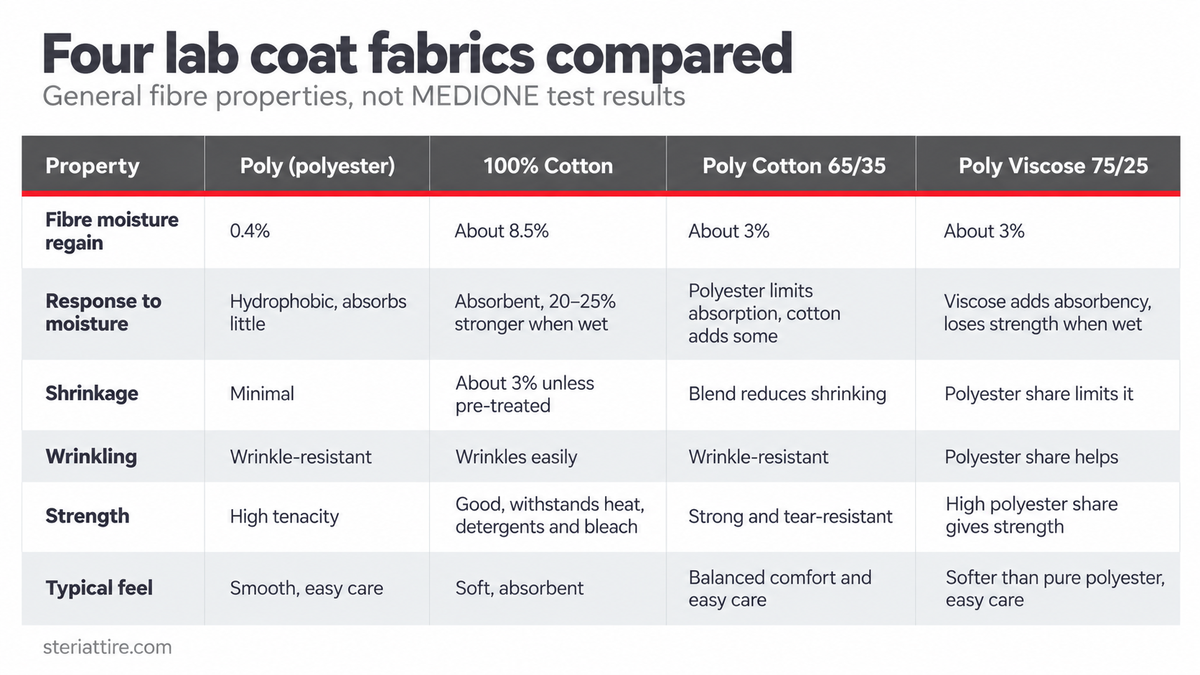
Values are general fibre properties from published sources, not MEDIONE test results.
Durability under repeated washing, and shrink resistance
Washing is the hardest test a hospital garment faces, harder than most shifts. Heat, alkaline detergents, bleach and mechanical action all work on fibres and stitches at once.
Shrinkage is often the first visible failure. Cotton fabric can shrink about 3% when washed unless pre-treated. On a lab coat, that can mean sleeves that ride above the wrist and a body that no longer closes comfortably. Polyester, by contrast, shows minimal shrinkage, and cotton-polyester blends reduce shrinking compared with pure cotton.
Durability also depends on more than the fibre. Even engineered fabrics lose performance with use, and in a study of reusable cleanroom garments, Eaton and Whyte (2021) found particle removal efficiency 26.1% lower than new fabric after 70 decontamination cycles. Fabrics age, and a garment programme should plan for it.
Our MEDIONE Doctor’s Coat is shrink-free and washable, made for long hours and repeated wear. Our 100% cotton white fabric is 270 GSM and is made for 80+ wash cycles, and we recommend washing it with a non-ionic detergent.
Tear resistance and colour retention
Ward work pulls at garments. Sleeves catch on bed rails, pockets catch on trolleys, seams stretch as the wearer bends to lift. A fabric with good tear strength survives these small accidents instead of turning them into holes.
Polyester fibres have high tenacity, and cotton-polyester blends are described as strong, wrinkle- and tear-resistant. That is one reason blends are common in workwear.
Colour matters for a different reason. In a hospital, colour often signals role. A doctor’s coat that has gone grey, or a blue gown that has faded unevenly, looks worn even when it is clean, and patients notice. Our MEDIONE Nurses Gown is tear-resistant, wrinkle-free and fade-resistant, made to be cleaned and reused many times.
Breathability and wearer comfort
Twelve hours is a long time to wear anything. A fabric that holds sweat against the skin, or traps heat, becomes something the wearer fights with.
Moisture regain is a useful indicator. Under standard conditions, cotton holds around 8.5% moisture by weight and viscose about 11%, while polyester holds only 0.4%. Fibre maker Swicofil describes viscose as the most absorbent of the cellulose fibres, with good breathability and moisture-wicking. Blends aim to keep some of that comfort without losing polyester’s easy care.
Our MEDIONE Doctor’s Coat is made from breathable and durable material, for staff who wear it through full shifts.

Lint-free construction
Lint is the small loose fibre that comes away from fabric during wear and handling. The US CDC notes that handling contaminated laundry with minimal agitation helps prevent the generation of potentially contaminated lint aerosols. Fibre shed by garments is part of what a hospital laundry has to manage.
Lint-free construction depends on the yarn, the weave and how cut edges are finished. Our MEDIONE Doctor’s Coat is lint-free, with a soft finish.
Functional features and why garment design matters
Good fabric can still become a poor garment. Design decides whether staff can work in it all day.
- Pockets placed where hands reach naturally, sized for pens, a phone or a small torch.
- Elastic cuffs that stay at the wrist when arms reach forward and sit well with gloves, so sleeves do not drag across a patient.
- Fit and sizing that allow bending, lifting and reaching without strain at the seams. MEDIONE garments come in sizes S to 3XL.
- On request, we can stitch RFID tags into garments as an optional add-on, so each garment’s history is on record rather than guessed.
Each detail is small. Repeated thousands of times across a hospital, they add up to garments people are glad to wear.
MEDIONE’s approach to hospital garments for repeated use
MEDIONE by SteriAttire is our range of reusable hospital garments for personnel attire. It includes our Re-usable Nurses Gown and Re-usable Doctor’s Coat, isolation gowns, and a new Lab Coat range in Poly, 100% Cotton, Poly Cotton 65/35 and Poly Viscose 75/25. Our Doctor’s Coat is shrink-free, breathable and lint-free, our Nurses Gown is tear-resistant, wrinkle-free and fade-resistant, and both come with pockets and elastic cuffs for daily clinical work. SteriAttire is ISO 13485:2016 certified and CDSCO approved.
When the fabric and construction are chosen well, a coat taken from the shelf after months of use still has a flat collar, closing cuffs and its original colour. Staff should never have to think about the fabric, the stitching or the wash cycles behind it.
See the MEDIONE Lab Coat range in four fabrics at steriattire.com
Frequently asked questions
Which fabric is best for a hospital lab coat? It depends on priorities. Polyester and poly-cotton blends offer strength, wrinkle resistance and low shrinkage, while 100% cotton offers higher absorbency and a cooler feel but can shrink about 3% unless pre-treated.
What is poly cotton 65/35? It is a blend of 65% polyester and 35% cotton. It combines polyester’s strength, wrinkle and tear resistance and low shrinkage with some of cotton’s absorbency.
Does polyester shrink in hot hospital laundry? Polyester fibres show minimal shrinkage compared with other fibres, which is why polyester-rich blends are widely used for garments washed repeatedly.
What makes a hospital garment suitable for repeated use? A fabric that keeps its size, strength, colour and comfort through repeated hot laundering, combined with durable seams, functional cuffs and pockets, and a way to track its use.
Sources
- ASTM D1909 Standard Tables of Commercial Moisture Regains for Textile Fibers · ASTM International
- Cotton Fibers and its Properties · Textile School
- Polyester · Wikipedia
- Viscose, Properties · Swicofil
- Laundry and Bedding, Environmental Infection Control · US CDC
- Effective Re-usable Cleanroom Garments and Evaluation of Garment Life · Eaton and Whyte, EJPPS (2021)